
From an English chemist’s shop to a bottle in our pantry
There are certain ingredients we use so routinely that we rarely stop to wonder where they came from. Worcestershire sauce is one of them.
A splash goes into meatloaf, burgers, marinades, gravies, soups and sauces, adding that little something you can taste but can’t quite identify.
At our house, it also started a pronunciation debate.
Dennis has long jokingly called it “Wor-Chester sauce.” So one afternoon I finally decided to settle the matter and looked up the proper pronunciation.
As it turns out, all those letters are rather misleading.
British English: WUSS-tuh-shuh
American English: WUSS-ter-sher
Both are recognizable pronunciations of Worcestershire, with the British pronunciation dropping even more of those intimidating-looking letters.
Once I had solved that little mystery, another occurred to me:
How did this unusual English sauce come to be in the first place?
And that story turned out to be even more interesting.
From Worcester, England
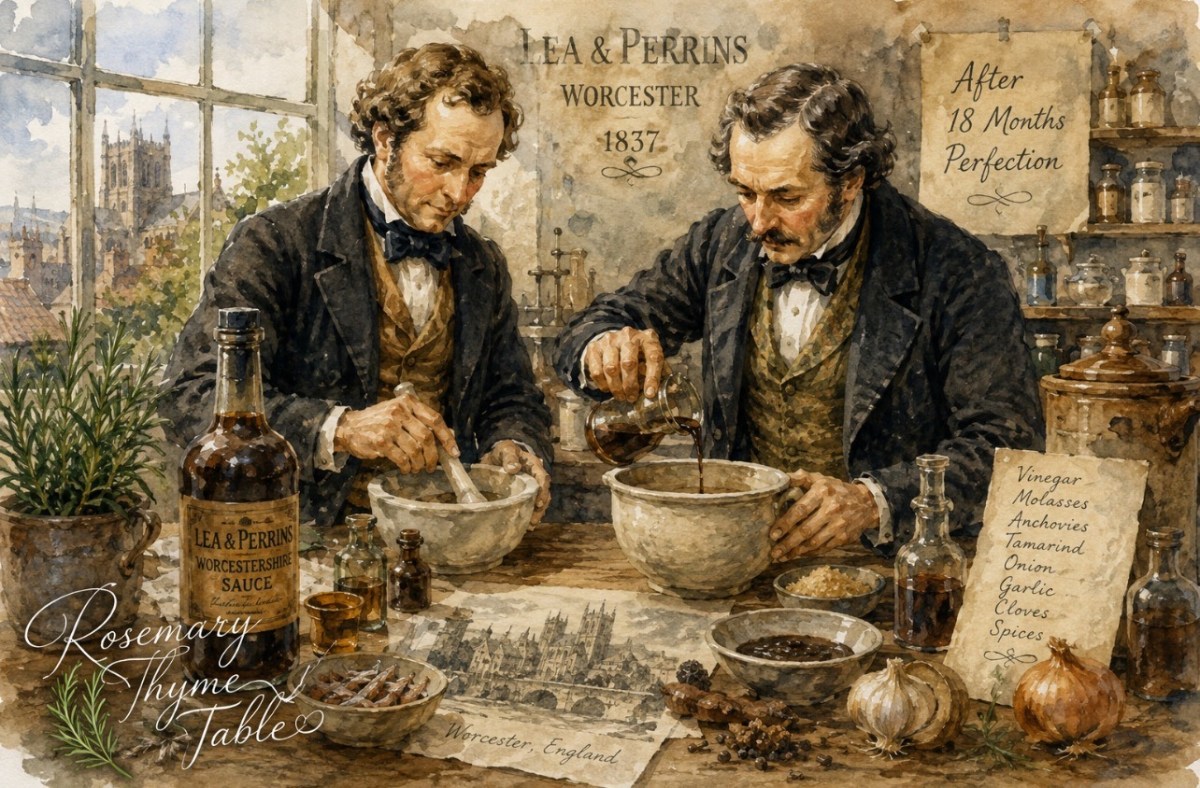
Worcestershire sauce takes its name from the English county of Worcestershire, and its story begins in the city of Worcester.
In the 1830s, two Worcester chemists, John Wheeley Lea and William Henry Perrins, created a savory condiment that would eventually bear their names.
In 1837, Lea & Perrins Worcestershire Sauce went on sale.
The company still produces its famous sauce in Worcester today.
A Sauce That Needed Time
One of the most delightful parts of the story is that Worcestershire sauce wasn’t simply mixed together one afternoon and immediately declared a success.
Time was an essential ingredient.
According to the history told by Lea & Perrins, the mixture was allowed to mature for 18 months. During that long aging process, the ingredients developed the deep and distinctive flavor that would eventually make Worcestershire sauce famous.
Even today, Lea & Perrins says its famous blend takes 18 months to mature.
There’s something wonderfully old-fashioned about that.
Some flavors simply cannot be hurried.
A Little Mystery From India
There’s another intriguing chapter in the Worcestershire story.
The traditional tale says the inspiration for the sauce came to England from India, where British travelers had encountered intensely flavored sauces and condiments.
For years, one version of the story credited a nobleman known as Lord Sandys, who supposedly returned from India wanting a sauce recreated for him.
Historians, however, have questioned parts of that story, particularly claims about Lord Sandys’ supposed position in Bengal.
So while Indian culinary influences very likely played a part in the sauce’s development, some of the colorful details handed down over the years may be a mixture of history and clever 19th-century storytelling.
Kitchen history often comes with a little mystery.
What Makes Worcestershire Sauce Taste Like Worcestershire Sauce?
Worcestershire sauce is difficult to describe because it isn’t simply salty, sweet, sour or savory.
It’s a little of everything.
The familiar Lea & Perrins sauce sold in America contains ingredients including vinegar, molasses, sugar, onion, anchovies, garlic, cloves, tamarind and chili pepper extract, along with other flavorings.
The anchovies provide deep savory flavor. Vinegar contributes acidity. Molasses and sugar add sweetness, while tamarind brings its own distinctive fruity tartness.
Then those flavors are given time to mingle and mature.
Today we have a wonderful word for much of the rich, savory quality Worcestershire brings to food:
Umami.
It helps explain why just a teaspoon or two can make a gravy, burger or meatloaf taste richer without anyone at the table necessarily being able to identify what’s in it.
From Worcester to Kitchens Around the World
Worcestershire sauce didn’t remain a local English curiosity for very long.
By the end of the 1840s, Lea & Perrins Worcestershire Sauce had developed an international reputation and was being exported throughout the British Empire.
Eventually, that distinctive little bottle traveled far beyond England.
Today Worcestershire sauce can be found in kitchens around the world, while the original Lea & Perrins sauce continues to be made in Worcester.
That’s quite a journey for something that began with two English chemists nearly two centuries ago.
The Little Bottle in the Pantry
Perhaps that’s what I enjoy most about kitchen history.
Our kitchens are filled with little connections to people and places we may never have thought about.
A bottle of Worcestershire sauce isn’t just something we shake into a meatloaf or stir into a gravy.
It connects today’s kitchen with two chemists in Worcester nearly two centuries ago, an old-fashioned process of aging and fermentation, ingredients and influences from different parts of the world, and generations of cooks who discovered that just a splash could make dinner taste a little better.
And now that I know its history, I think I’ll appreciate that familiar little bottle a bit more the next time I reach for it.
I will also pronounce it correctly:
WUSS-ter-sher.
Dennis, however, will almost certainly continue to call it “Wor-Chester sauce.”
Some family traditions are apparently harder to change than others. 😂
Rosemary Thyme Kitchen History
Stories from the ingredients, dishes and traditions that found their way to our tables.
Rosemary Thyme Table — Fall in Love with Home Again. 🌿
Discover more from Rosemary Thyme
Subscribe to get the latest posts sent to your email.
