Today is the first full day of autumn—my absolutely favorite time of year.
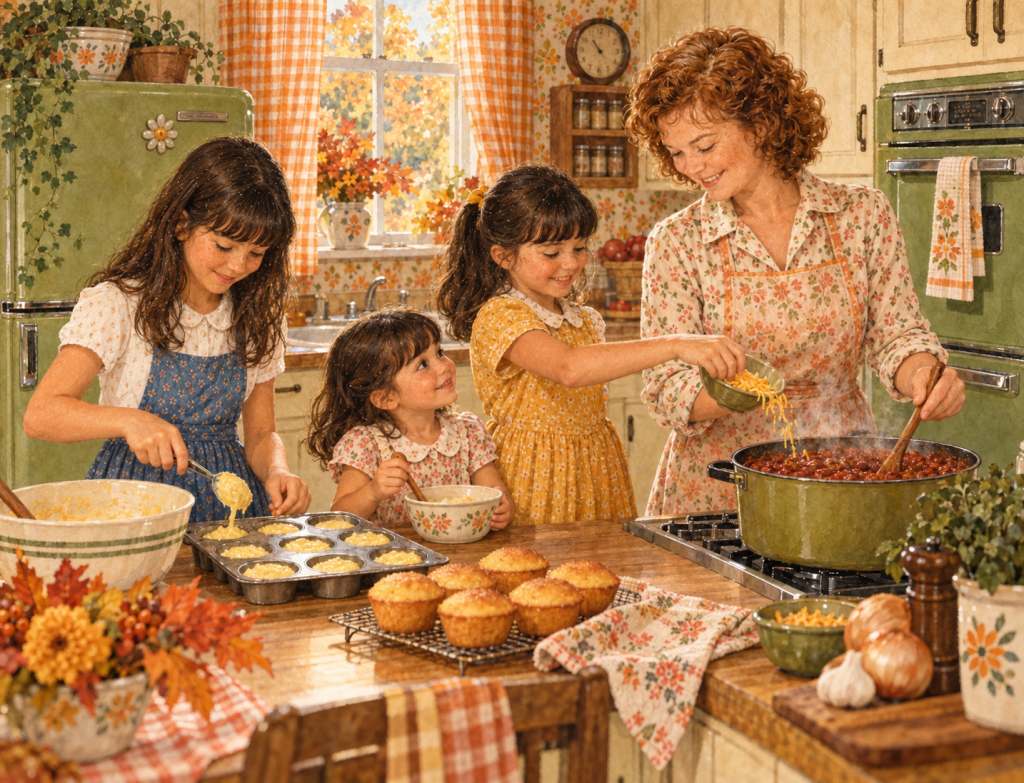
For generations, the autumn kitchen has been the warm heart of the home. After the harvest, families gathered to preserve garden vegetables, bake bread, simmer soups and stews, and prepare comforting meals for the colder days ahead. It was a season of abundance, gratitude, and making good use of everything the garden and harvest provided.
That may be one reason autumn cooking still feels so comforting today.
When the weather begins to cool, I love being in my kitchen again. This is the season when my slow cooker earns its place on the counter and our table fills with hearty soups, savory stews, warm bowls of chili, freshly baked breads, apple desserts, and all the cozy foods we wait for throughout the year.
There is something wonderful about coming inside from the crisp autumn air and smelling dinner slowly cooking. Autumn invites us to slow down, gather around the table, and enjoy the simple warmth of home.
Here’s to colorful leaves, cooler evenings, favorite recipes, and a kitchen filled with the comforting aromas of autumn. 🍁🥣
What is the first cozy dish you look forward to making when autumn arrives?
🌿 While the World Changed, the Kitchen Stayed Familiar
The other day, Zach and I were watching the movie 9 to 5. The secretaries were sitting at their desks using electric typewriters, and I found myself explaining to him that this was exactly how I started working.
And then I remembered carbon paper. 😆
If you made a mistake on a four-part bill of lading, correcting it was practically an art form. You had to line all those copies back up in the typewriter perfectly so the corrected letter or number didn’t end up too high, too low, or sitting off to one side.
There was no backspace button that magically made everything disappear. 😂
Even after computers began appearing in offices, the workplace was still noisy. Phones rang constantly. Customers called in orders. People talked across desks. Filing cabinet drawers opened and closed all day long.
Then I left the workforce for a number of years while my children were young.
When I eventually returned, I couldn’t believe how much had changed.
The office was almost silent.
Orders that once came over the telephone now arrived electronically. You reviewed them, completed them and sent them on their way without ever speaking to the customer. Filing cabinets were disappearing. Paper was disappearing. So many things that had once seemed like permanent parts of working life were simply gone.
And recently it occurred to me how different that is from another room where I’ve spent a great deal of my life.
My kitchen.
I walk into my kitchen today and find my cast-iron pans. My casserole dishes. Mixing bowls and measuring cups. Wooden spoons. Pots and pans. And my Colletti stovetop coffee pot quietly making coffee much the way coffee has been made for generations.
Of course, kitchens have changed too. We have microwaves, toaster ovens, food processors, air fryers and all sorts of wonderful conveniences.
But somehow, most of those things didn’t replace the old tools.
They simply joined them.
Perhaps the biggest change has been the way we find our recipes. Once we opened a cookbook, pulled a handwritten card from a recipe box or clipped something from the newspaper. Today we can find a recipe on our phones—or even ask artificial intelligence to help us create one.
And then we put down the phone and pick up the wooden spoon.
They have always said that the kitchen is the heart of the home.
Maybe one reason that remains so true for me is that when I walk into my kitchen, I am surrounded by familiar things that have hardly changed at all.
The world outside that room has changed enormously during my lifetime. The way we work, communicate, shop and find information would have been almost unimaginable to the young woman sitting behind that electric typewriter.
But there is peace in walking into my kitchen and finding so much that is familiar.
I can pick up a cast-iron skillet, take a casserole dish from the cupboard, put the coffee pot on the stove and do something much the same way generations before me did.
Maybe that’s part of what makes a kitchen the heart of a home.
It isn’t simply where we prepare our food.
It’s one of the places where the past and the present are allowed to live comfortably together.
We can welcome the new, keep what was good about the old, and somehow make room for both.
And at the end of the day, no matter how much the world changes, there is still something wonderfully familiar about putting supper on the table and calling the people you love to come eat.
The world changed. Somehow, wonderfully, the kitchen stayed familiar. 🌿💛🏡
Helene Rosemary Thyme 🌿😊 Fall in Love with Home Again 💛🏡
Do you grow rosemary in your garden or keep a pot of it in your kitchen?
⸻
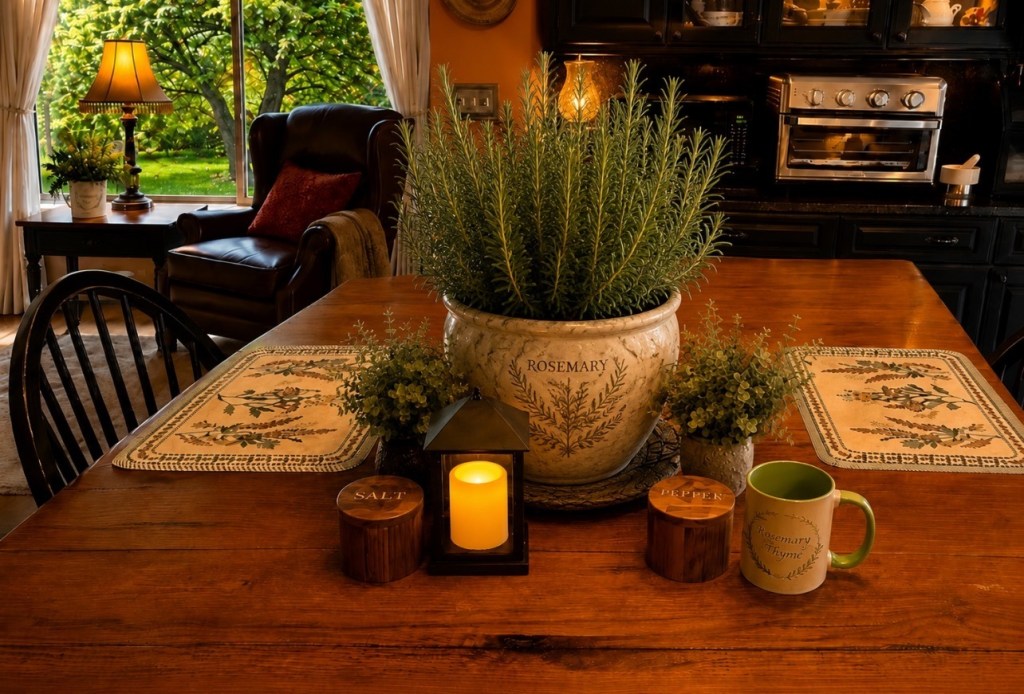
If there is one herb that perfectly represents the spirit of Rosemary Thyme, it is, of course… rosemary.
For thousands of years, this fragrant evergreen herb has found its way into kitchens, gardens, and homes around the world.
The ancient Greeks and Romans treasured rosemary not only for its wonderful flavor but also as a symbol of remembrance, loyalty, and friendship. Students are said to have worn sprigs of rosemary while studying, believing it would help strengthen their memory.
During the Middle Ages, rosemary often grew just outside the kitchen door, where cooks could snip a few fragrant sprigs to season soups, roasted meats, breads, and vegetables. Its fresh, pine-like aroma filled farmhouse kitchens and became part of everyday family life.
One of my favorite historical references comes from William Shakespeare’s Hamlet, where Ophelia says:
“There’s rosemary, that’s for remembrance.”
What a beautiful thought.
I think that’s one of the reasons I’ve always loved rosemary so much.
Its fragrance has a remarkable way of bringing back memories—Sunday dinners around the family table, fresh bread coming from the oven, herbs growing in the summer garden, and meals shared with the people we love.
For me, rosemary represents much more than an herb.
It reminds me that our kitchens are places where memories are created one meal at a time.
Every loaf of bread we bake, every family dinner we prepare, every holiday meal we share becomes part of our family’s story.
Perhaps that’s why rosemary has remained a favorite for so many centuries.
It reminds us that some of life’s greatest blessings are found in the simple moments gathered around the table.
Wishing you a peaceful and blessed day.
🌿 Images in this post were created or enhanced with AI assistance.
Did your parents or grandparents have a root cellar?
Long before refrigerators and freezers, families had another way to keep food fresh.
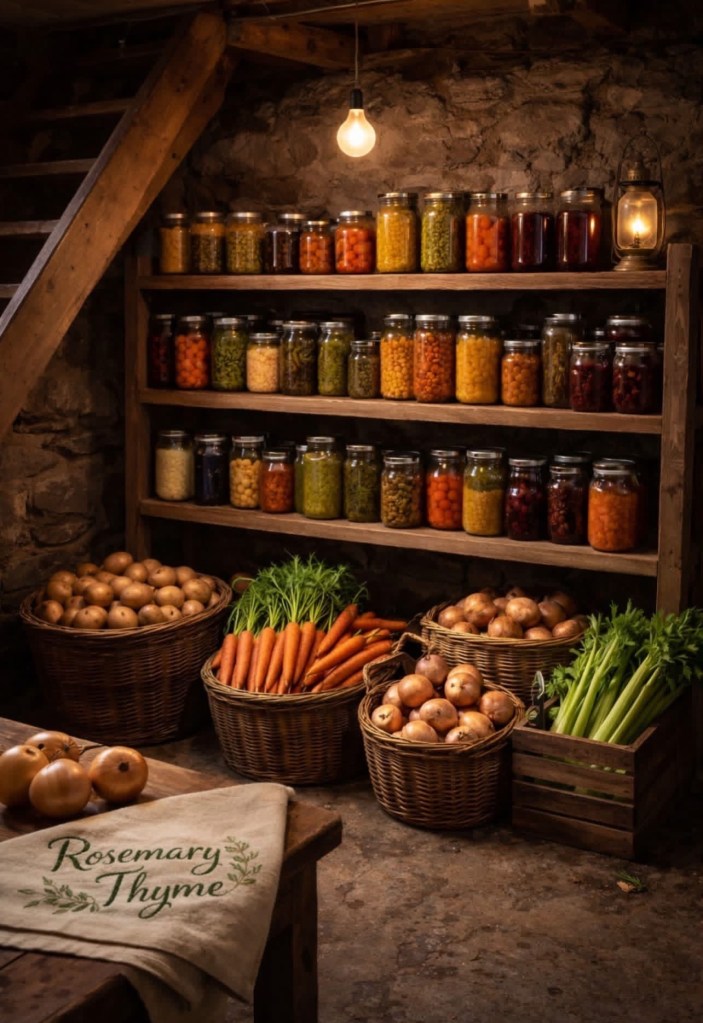
Root cellars have been used for centuries throughout Europe and later across North America. Built partially or completely underground, they stayed naturally cool and humid throughout the year. Potatoes, carrots, onions, apples, cabbage, squash, and jars of home-canned vegetables could be stored for months without electricity.
For farming families, the root cellar wasn’t simply a place to store food—it was peace of mind. A good harvest carefully tucked away in autumn meant there would still be food on the table during the long winter months.
As electricity came into our homes, refrigerators and freezers slowly replaced many traditional root cellars. Yet in many ways, the idea never disappeared.
Today, many of us have a modern version. Extra refrigerators in the basement, upright freezers, pantry shelves filled with home-canned foods, vacuum-sealed meats, and organized storage all carry on the same tradition our grandparents knew so well.
The tools have changed, but the heart behind them hasn’t.
Preparing for tomorrow has always been one of the quiet ways we care for our families.
🌿 At the Rosemary Thyme Table, we remember that some of the best ideas are the ones worth keeping.
From an English chemist’s shop to a bottle in our pantry
There are certain ingredients we use so routinely that we rarely stop to wonder where they came from. Worcestershire sauce is one of them.
A splash goes into meatloaf, burgers, marinades, gravies, soups and sauces, adding that little something you can taste but can’t quite identify.
At our house, it also started a pronunciation debate.
Dennis has long jokingly called it “Wor-Chester sauce.” So one afternoon I finally decided to settle the matter and looked up the proper pronunciation.
As it turns out, all those letters are rather misleading.
British English:WUSS-tuh-shuh American English:WUSS-ter-sher
Both are recognizable pronunciations of Worcestershire, with the British pronunciation dropping even more of those intimidating-looking letters.
Once I had solved that little mystery, another occurred to me:
How did this unusual English sauce come to be in the first place?
And that story turned out to be even more interesting.
From Worcester, England
Worcestershire sauce takes its name from the English county of Worcestershire, and its story begins in the city of Worcester.
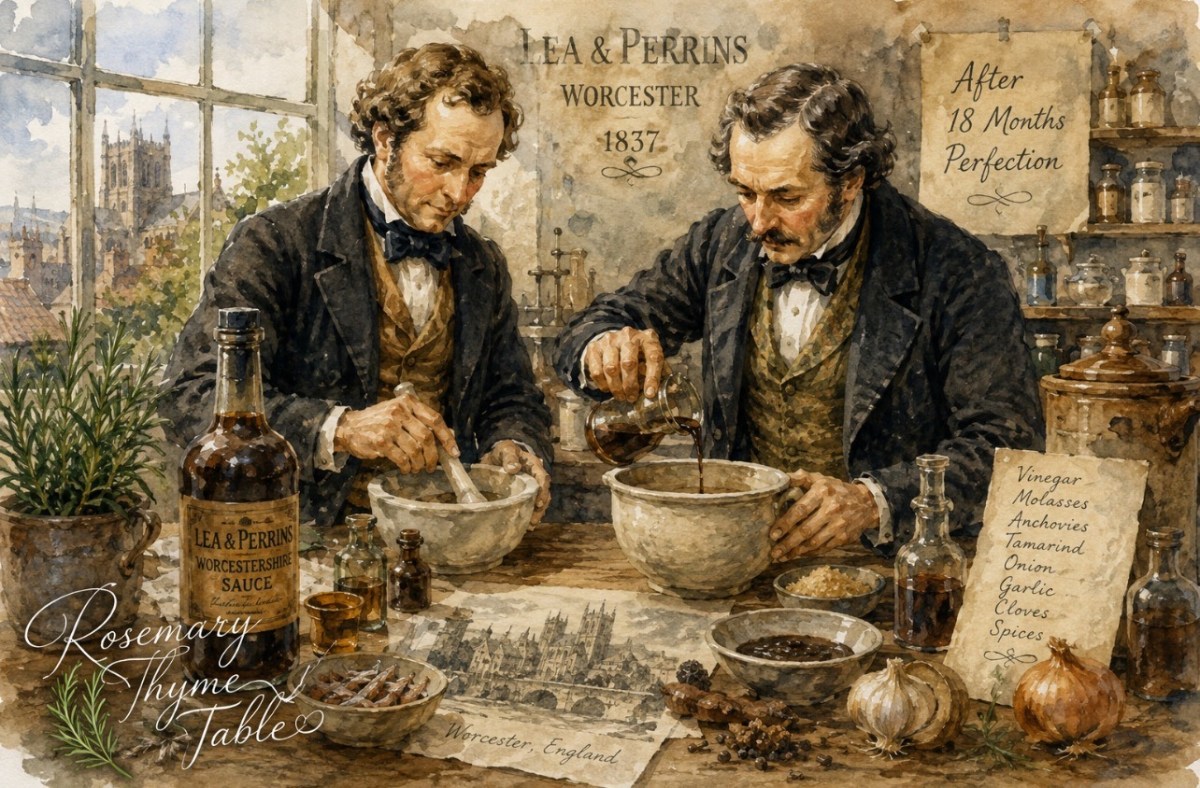
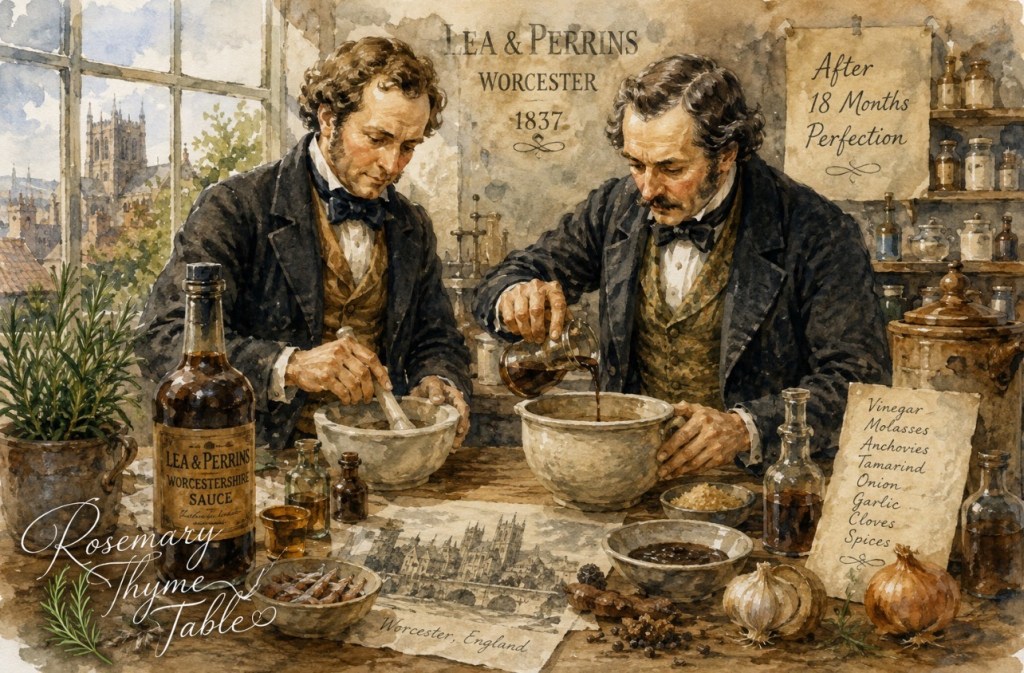
In the 1830s, two Worcester chemists, John Wheeley Lea and William Henry Perrins, created a savory condiment that would eventually bear their names.
In 1837, Lea & Perrins Worcestershire Sauce went on sale.
The company still produces its famous sauce in Worcester today.
A Sauce That Needed Time
One of the most delightful parts of the story is that Worcestershire sauce wasn’t simply mixed together one afternoon and immediately declared a success.
Time was an essential ingredient.
According to the history told by Lea & Perrins, the mixture was allowed to mature for 18 months. During that long aging process, the ingredients developed the deep and distinctive flavor that would eventually make Worcestershire sauce famous.
Even today, Lea & Perrins says its famous blend takes 18 months to mature.
There’s something wonderfully old-fashioned about that.
Some flavors simply cannot be hurried.
A Little Mystery From India
There’s another intriguing chapter in the Worcestershire story.
The traditional tale says the inspiration for the sauce came to England from India, where British travelers had encountered intensely flavored sauces and condiments.
For years, one version of the story credited a nobleman known as Lord Sandys, who supposedly returned from India wanting a sauce recreated for him.
Historians, however, have questioned parts of that story, particularly claims about Lord Sandys’ supposed position in Bengal.
So while Indian culinary influences very likely played a part in the sauce’s development, some of the colorful details handed down over the years may be a mixture of history and clever 19th-century storytelling.
Kitchen history often comes with a little mystery.
What Makes Worcestershire Sauce Taste Like Worcestershire Sauce?
Worcestershire sauce is difficult to describe because it isn’t simply salty, sweet, sour or savory.
It’s a little of everything.
The familiar Lea & Perrins sauce sold in America contains ingredients including vinegar, molasses, sugar, onion, anchovies, garlic, cloves, tamarind and chili pepper extract, along with other flavorings.
The anchovies provide deep savory flavor. Vinegar contributes acidity. Molasses and sugar add sweetness, while tamarind brings its own distinctive fruity tartness.
Then those flavors are given time to mingle and mature.
Today we have a wonderful word for much of the rich, savory quality Worcestershire brings to food:
Umami.
It helps explain why just a teaspoon or two can make a gravy, burger or meatloaf taste richer without anyone at the table necessarily being able to identify what’s in it.
From Worcester to Kitchens Around the World
Worcestershire sauce didn’t remain a local English curiosity for very long.
By the end of the 1840s, Lea & Perrins Worcestershire Sauce had developed an international reputation and was being exported throughout the British Empire.
Eventually, that distinctive little bottle traveled far beyond England.
Today Worcestershire sauce can be found in kitchens around the world, while the original Lea & Perrins sauce continues to be made in Worcester.
That’s quite a journey for something that began with two English chemists nearly two centuries ago.
The Little Bottle in the Pantry
Perhaps that’s what I enjoy most about kitchen history.
Our kitchens are filled with little connections to people and places we may never have thought about.
A bottle of Worcestershire sauce isn’t just something we shake into a meatloaf or stir into a gravy.
It connects today’s kitchen with two chemists in Worcester nearly two centuries ago, an old-fashioned process of aging and fermentation, ingredients and influences from different parts of the world, and generations of cooks who discovered that just a splash could make dinner taste a little better.
And now that I know its history, I think I’ll appreciate that familiar little bottle a bit more the next time I reach for it.
I will also pronounce it correctly:
WUSS-ter-sher.
Dennis, however, will almost certainly continue to call it “Wor-Chester sauce.”
Some family traditions are apparently harder to change than others. 😂
Rosemary Thyme Kitchen History Stories from the ingredients, dishes and traditions that found their way to our tables.
Rosemary Thyme Table — Fall in Love with Home Again. 🌿