Today is the first full day of autumn—my absolutely favorite time of year.
For generations, the autumn kitchen has been the warm heart of the home. After the harvest, families gathered to preserve garden vegetables, bake bread, simmer soups and stews, and prepare comforting meals for the colder days ahead. It was a season of abundance, gratitude, and making good use of everything the garden and harvest provided.
That may be one reason autumn cooking still feels so comforting today.
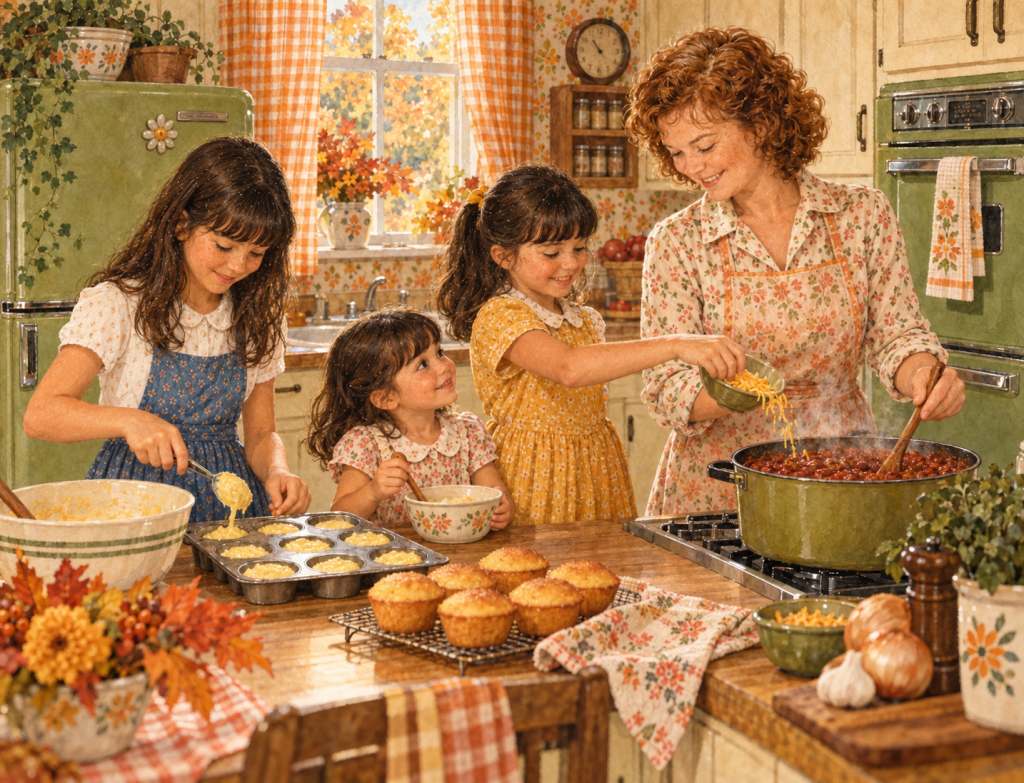
When the weather begins to cool, I love being in my kitchen again. This is the season when my slow cooker earns its place on the counter and our table fills with hearty soups, savory stews, warm bowls of chili, freshly baked breads, apple desserts, and all the cozy foods we wait for throughout the year.
There is something wonderful about coming inside from the crisp autumn air and smelling dinner slowly cooking. Autumn invites us to slow down, gather around the table, and enjoy the simple warmth of home.
Here’s to colorful leaves, cooler evenings, favorite recipes, and a kitchen filled with the comforting aromas of autumn. 🍁🥣
What is the first cozy dish you look forward to making when autumn arrives?
“Blessed is the one who trusts in the Lord, whose confidence is in him. They will be like a tree planted by the water that sends out its roots by the stream. It does not fear when heat comes; its leaves are always green. It has no worries in a year of drought and never fails to bear fruit.”
— Jeremiah 17:7–8
There is a quiet beauty in aging.
When we are young, we often admire the blossoms. We notice what is new, what is growing, and what is changing. We rarely think about roots because we cannot see them.
But after living through enough years, enough joys, and enough storms, we begin to understand that the roots were the important part all along.
Life brings storms to every person. Some arrive suddenly. Others linger longer than we ever imagined. There are seasons of loss, disappointment, worry, illness, uncertainty, and heartache. None of us escapes them.
Yet there is a gift that often comes with age.
We begin to recognize what has held us steady.
For me, it has been family.
Home.
Faith.
The kitchen table.
The garden.
The traditions passed from one generation to another.
The ordinary routines that seemed so small at the time but became the foundation of a life.
As I have grown older, I have come to realize that our roots are rarely ours alone. They are all intertwined, one shooting off from another. We are rooted in the people who came before us—the parents and grandparents who taught us, the faith that was passed down, the family stories we carry, and the lessons learned around kitchen tables and front porches.
In turn, our roots become part of someone else’s story. The values we live, the kindness we show, the meals we share, and the faith we carry become roots for those who come after us.
For many years I thought being rooted meant being tied down. I thought roots might prevent us from growing or exploring. But experience has taught me something different.
Roots are not chains. They are protection in a storm.
When the winds of life begin to blow, it is not the shallow-rooted tree that survives. It is the one whose roots run deep beneath the surface, anchored in something stronger than the storm itself.
Looking back, I can see that the things that rooted me were never limitations. They were gifts. They gave me stability when life felt uncertain. They gave me comfort when I was afraid. They gave me purpose when I felt lost.
The world often tells us to keep moving, keep changing, keep searching for the next thing. But there is wisdom in staying rooted in what matters most.
Family.
Faith.
Home.
Love.
A life built slowly and faithfully over time.
And perhaps that is one of the quiet gifts of aging. We begin to see that the deepest roots are often the ones we once took for granted.
They carried us through every storm.
They sustained us during every drought.
And by God’s grace, they continue to bear fruit.
“The righteous will flourish like a palm tree… They will still bear fruit in old age, they will stay fresh and green.”
— Psalm 92:12,14
There is a quiet beauty in aging because, after enough years, we begin to recognize the roots that carried us through life’s storms—and we learn to be grateful for them.
🙏Sunday Reflection: How Love Changes from 26 to 66 🕊️
“Two are better than one… If either of them falls down, one can help the other up.” — Ecclesiastes 4:9-10
At 26, love may look like flowers, long conversations, and not wanting the evening to end.
At 66, love may look like a husband driving you to a doctor’s appointment and pulling up to the door so you don’t have to walk as far.
At 26, love may say, “Do you really have to go?”
At 66, love may say, “Call me when you’re ready, and I’ll pull the car around.”
Love changes through the years, but when it is rooted in faithfulness, it does not become less beautiful.
It becomes deeper.
The grand gestures may become fewer, but the quiet acts of care become more precious.
A hand held.
A ride to an appointment.
A cup of coffee waiting in the morning.
Someone who notices when you’re tired.
Someone who stays.
Perhaps one of God’s sweetest gifts is allowing us to discover that love is not measured by how loudly it speaks, but by how faithfully it remains.
💛 Love isn’t just about being 26. It’s about being blessed enough to reach 66 together and finding that after all those years, the simplest words can still mean the most:
“I’m here.”
If this kind of quiet moment speaks to you, you’re always welcome at Rosemary Thyme. 💛
September 11, 2001, is one of those days when most of us can remember exactly where we were and what we were doing when we realized something terrible was happening.
I remember the enormous grief I felt as the news unfolded. I thought about the people who had gone to work that morning, the passengers aboard the airplanes, the first responders running toward danger, and all the families whose lives were suddenly and forever changed.
I remember fear, too.
None of us knew what might happen next. We didn’t yet understand the full scope of what had happened or whether more attacks were coming.
But while something extraordinary and frightening was happening beyond our home, inside our kitchen something very ordinary was happening.
My children needed breakfast.
Olivia was only one year old, and Zachary was three. They sat in their high chairs at our kitchen table, and I sat between them as I always did—spoon-feeding Olivia and helping Zachary with his food.
I kept our morning routine.
After breakfast, I got out their toys, and their little day continued. They were much too young to understand what was happening. In the background, I listened to the news and tried to comprehend what was happening to our country.
Looking back after all these years, I realize there was something important in that ordinary routine.
In moments of crisis, we remain constant.
We make breakfast. We care for the people who depend upon us. We keep the familiar rhythms of home going even when the world beyond our doors suddenly feels terribly uncertain.
And that particular morning, there was something else quietly resting in my heart.
Only four months earlier, Olivia had come home from India.
Now she was sitting beside me in her high chair.
She was home. She was safe.
As I listened to stories of families experiencing unimaginable loss, I felt enormous grief for them. I felt fear about what might happen next.
And at the very same time, I felt profound relief and gratitude that my daughter was safely home.
It wasn’t gratitude instead of grief.
It was gratitude in the midst of grief.
Perhaps that is one of the things September 11 still teaches me twenty-five years later.
We cannot control everything happening beyond our doors. We can remain aware. We can prepare wisely. We can pray for our country and for those entrusted with protecting it.
And then we return to what God has placed within our care—the people we love, the home we tend, the meals we prepare, and the ordinary responsibilities of another day.
Sometimes remaining constant is itself an act of faith.
🙏 A Prayer for September 11
Lord, help us to be watchful without being fearful, informed without being consumed, and prepared without losing our peace.
Protect our country and those who guard it. Watch over those who serve in places we may never see and in ways we may never know.
Comfort the families who still carry the losses of September 11. Help us remember those whose lives ended that morning and those who ran toward danger to help others.
When the troubles of the world make us afraid, remind us to do what we can, love those entrusted to us, and place what we cannot control into Your hands.
And even in difficult times, teach us never to overlook the blessings already safely gathered around our own table.
Amen. 🙏
🇺🇸 We remember.
Helene Rosemary Thyme 🌿 Fall In Love With Home Again 💛🏡
Many people dream of escaping to a quiet cabin beside a lake.
We imagine that peace lives somewhere else—far from traffic, noise, schedules, obligations, and the constant demands of daily life. We tell ourselves that if only we could find the right place, then we would finally feel at rest.
Henry David Thoreau went to Walden Pond searching for a simpler life. His writings have inspired generations of people to slow down, notice more, and live intentionally.
But over the years, I’ve come to believe that the greatest lesson of Walden may not have been about the pond at all.
It was about learning to notice.
Most of us cannot move to a cabin in the woods. We have homes to care for, meals to prepare, laundry baskets to fold, and people who depend on us.
Yet peace is still available.
A pot of herbs growing on a deck.
A comfortable chair by a window.
A faithful dog sleeping nearby.
A favorite book resting on the table.
A cup of coffee enjoyed before the house wakes up.
Birdsong playing softly in the background.
A candle glowing on a winter evening.
A simple meal shared with someone we love.
These things may seem small, but small things have a way of becoming a sanctuary.
I have learned that creating your own Walden Pond is not a hard thing to do.
It is an intentional thing to do.
Peace rarely arrives because of a change of address. More often, it arrives because of a change in attention.
We begin to notice the beauty already around us.
We stop rushing past the ordinary moments.
We create little pockets of calm in our homes and in our days.
That, in many ways, is the heart of Rosemary Thyme.
Not perfection.
Not luxury.
Not a larger house.
Simply learning to fall in love with home again.
Wherever you live, whatever season of life you are in, perhaps this week you can create a small Walden Pond of your own—a quiet corner, a peaceful habit, a simple moment of gratitude.
You may discover that peace was never as far away as you thought.
What is one memory from your family table that has stayed with you throughout your life?
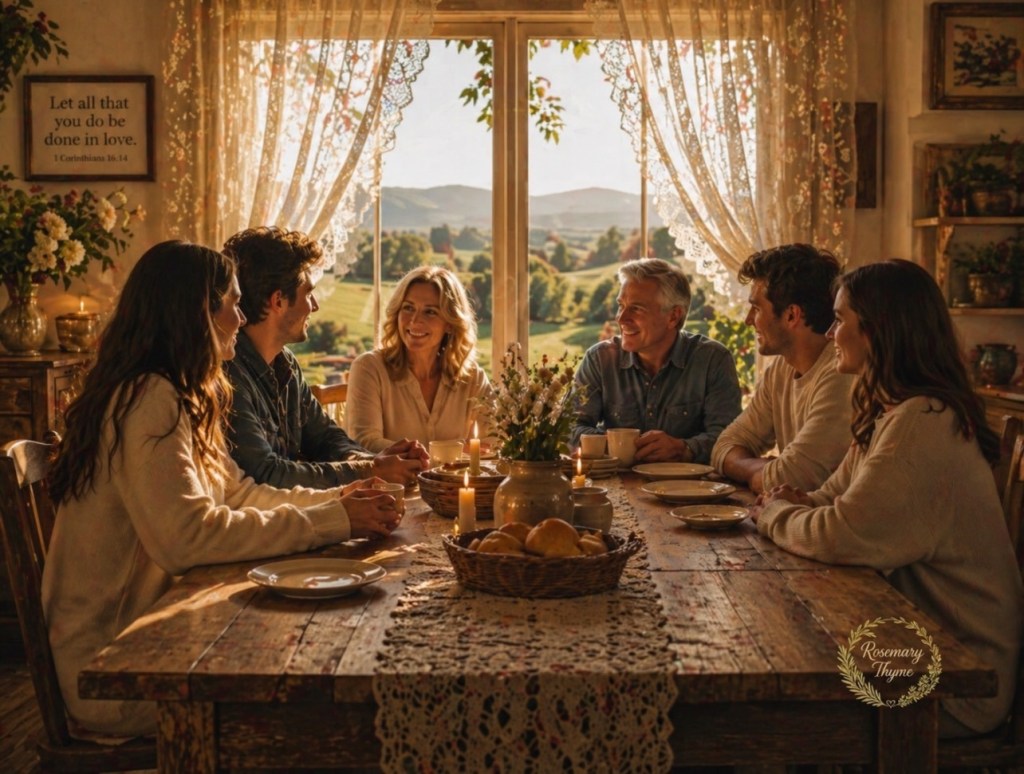
There are so many things that fill our calendars today, but I wonder if one of the most important moments of the day is also one of the easiest to overlook—the time we spend around the table together.
Our family meals aren’t fancy. But I do try to make them feel special.
I set the table with our good dishes and our good stainless steel, not because it’s a holiday, but because an ordinary Tuesday is worth celebrating too. I often think ahead about things we can talk about so that our meal becomes more than eating—it becomes time together.
One thing we’ve chosen to do is leave our phones away from the table. For just a little while, we give one another our full attention.
Sometimes we laugh. Sometimes we solve problems together. Sometimes we simply talk about our day. Those conversations may seem ordinary now, but I believe they’re quietly becoming tomorrow’s cherished memories.
I do wonder about the next generation. With phones always within reach, I hope we don’t lose the beautiful art of conversation. Looking into someone’s eyes, listening without distraction, asking questions, sharing stories, and enjoying comfortable silence are gifts that can’t be replaced by a screen.
A meal is over in twenty or thirty minutes.
The memories made around that table can last a lifetime.
“Let your conversation be always full of grace, seasoned with salt.” — Colossians 4:6
May your table today be filled with good food, meaningful conversation, and the simple joy of being together.
“A time to weep, and a time to laugh; a time to mourn, and a time to dance.” — Ecclesiastes 3:4
There are moments in history that become woven into the memories of a family.
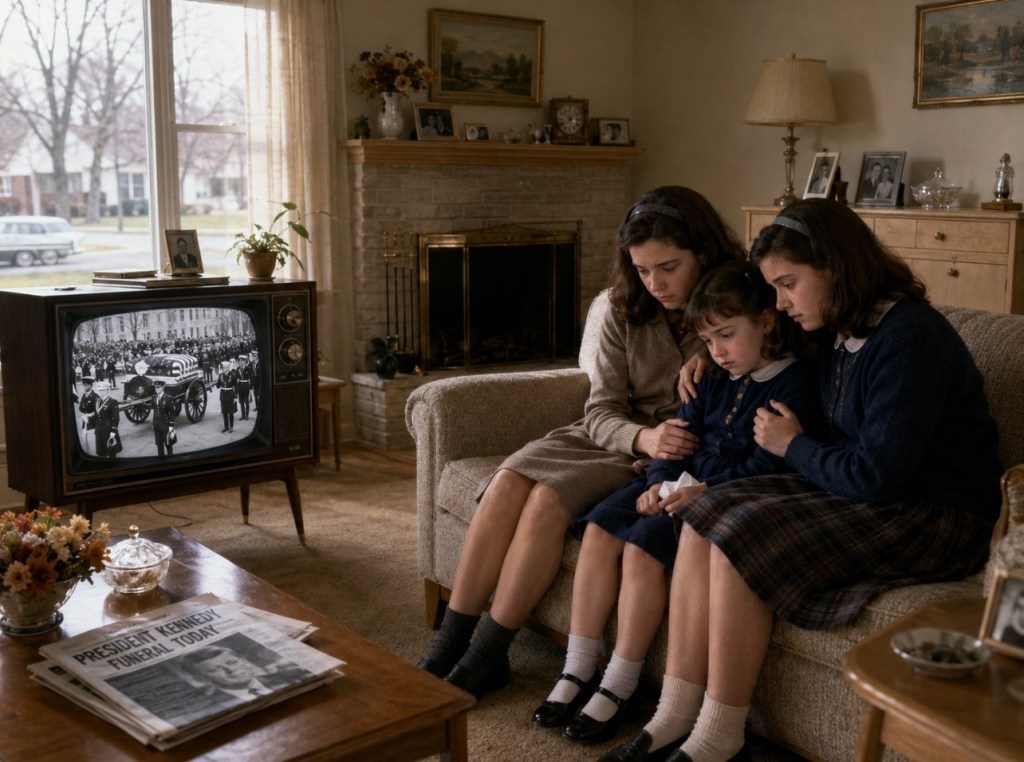
I was only four years old when President John F. Kennedy was assassinated in November of 1963. I was far too young to understand politics, or even to fully understand what had happened. But I understood that something was terribly wrong.
I remember my parents becoming very emotional over President Kennedy’s death. I remember my sisters crying as we watched the funeral on television. And even as a little girl, I could feel the sadness that seemed to have settled over our home and across the entire country.
There was another reason our family watched that funeral so closely.
My brother was attending the United States Naval Academy at Annapolis at the time, and as the naval midshipmen appeared during the funeral ceremonies, my sisters and I searched the television screen, hoping we might catch a glimpse of him among them.
So intertwined with my memory of a nation mourning its president is this very ordinary family memory: sisters sitting together, watching television, grieving with their parents, and looking through rows of young men in uniform for their brother.
All these years later, I am struck by how much children notice.
We may not understand the words being spoken around us. We may not understand history, politics, tragedy, or death. But we understand the faces of the people we love. We notice when our mother cries. We notice when our father grows quiet. We know when the world inside our home suddenly feels different.
Scripture reminds us that life contains many seasons.
There is a time to laugh and a time to weep. There is a time to celebrate and a time to mourn.
Faith does not ask us to pretend that sorrow does not exist. It gives us a place to carry it.
And perhaps that is one reason certain memories remain with us for a lifetime. They remind us not only of what happened, but of who stood beside us when it happened.
Today, as I remember November 1963, I remember President Kennedy and a nation stunned by tragedy.
But I also remember my family.
I remember my parents.
I remember my sisters’ tears.
I remember searching the television screen for my brother.
And I remember a four-year-old little girl who could not possibly understand everything she was witnessing, but somehow understood that it mattered.
Our homes hold these memories for us.
The joyful ones.
The painful ones.
The ordinary ones.
And together, they become part of the story of a family.
There is indeed a time to mourn. And there is also a time to remember.
🌿 Helene Rosemary Thyme 🌿😊 Fall in Love with Home Again 💛🏠







 Rosemary Thyme