There’s something so satisfying about a simple supper that comes together on one pan…
A hot cast-iron baking sheet,
a handful of good ingredients,
and the kind of meal that fills the kitchen with warmth before it ever reaches the table.
This is one of those meals.
⸻
Ingredients
Potatoes & Vegetables
• 1 lb baby potatoes, halved
• 12 oz fresh green beans, trimmed
• 1 medium sweet onion, sliced into thick wedges
• 2–3 tbsp olive oil (divided)
Steak Bites
• 1½ lbs sirloin steak, cut into bite-size pieces
• 1 tbsp olive oil
• 1 tsp Worcestershire sauce
Seasoning (Rosemary Thyme Style)
• 1 tsp garlic powder
• 1 tsp onion powder
• 1 tsp dried rosemary (or powdered)
• 1 tsp dried thyme
• ½ tsp smoked paprika
• black pepper to taste
Finish
• 1 tbsp melted butter
• squeeze of fresh lemon juice
• chopped parsley (optional)
• pinch of fleur de sel (optional)
⸻
Instructions
1. Preheat oven to 425°F and place your cast-iron baking sheet inside to heat.
2. In a bowl, toss the potatoes with about 1½ tbsp olive oil and half of the seasoning blend.
3. Carefully remove the hot pan and spread potatoes out in a single layer.
Roast for 15 minutes.
4. While potatoes cook, toss steak bites with olive oil, Worcestershire, and remaining seasoning.
5. In another bowl, toss green beans and onions with remaining olive oil and a light sprinkle of seasoning.
6. Remove pan from oven. Add steak, green beans, and onions—spread everything out so it roasts, not steams.
7. Return to oven and cook 10–12 minutes, stirring once halfway through, until steak is browned and vegetables are tender.
8. Drizzle with melted butter and a squeeze of lemon juice just before serving.
⸻
Rosemary Thyme Kitchen Tip
A hot pan makes all the difference.
Starting your cast-iron baking sheet in the oven gives you that beautiful sear on the potatoes and steak—just like a skillet, but with the ease of a sheet-pan meal.
⸻
Rosemary Thyme Blessing
May your table be filled with simple meals,
your kitchen with warmth,
and your home with the quiet joy of cooking for those you love.
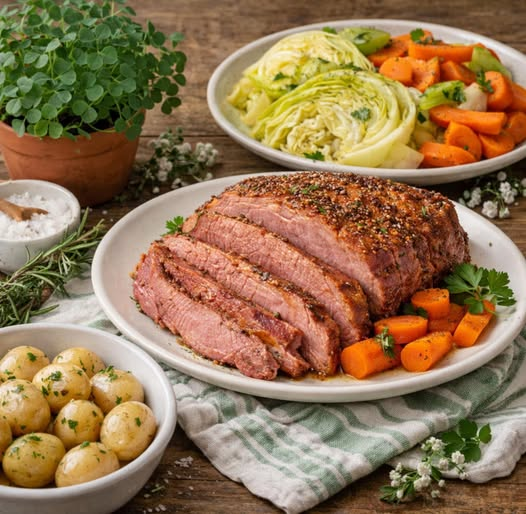
Corned beef and cabbage with carrots and potatoes, alongside warm Irish soda bread, has been one of our family’s St. Patrick’s Day traditions for many years.
In the early days, I always made it the way so many of us learned — simmering on the stove for hours and hours. Then one year I looked over at my crockpot and thought… I bet this would work just as well — maybe even better.
Well, it turns out… it does.
Slow cooking the corned beef makes it beautifully tender and full of that cozy, savory flavor we all love.
And the funny thing is — every single year when we sit down to this meal, someone at the table says:
“Why don’t we make this more than once a year? It’s so delicious.”
Some traditions are just too good to keep only once a year.
• 1 tablespoon brown sugar (added to the last hour of slow cooking directly to the broth, NOT on top of meat)
Optional gentle flavor boost (choose one if desired):
• 1–2 teaspoons apple cider vinegar or
• ½ teaspoon mustard seeds
If you get your meat from the butcher like I do, it may not come with the package of spices. Below is a list of ground spices that you can use in place of the spice packet.
Crockpot Corned Beef Spice Blend
(for about a 3–4 lb corned beef)
• 1 teaspoon ground coriander
• 1/2 teaspoon ground allspice
• 1/4 teaspoon ground ginger
• 1/8 teaspoon ground cinnamon
• 1/8 teaspoon ground cloves (a little goes a long way)
• 1 teaspoon dry mustard powder
• 1/2 teaspoon black pepper
(Mix spices together in a small bowl)
• 2 bay leaves (if you have them)
How to use
1. Place the corned beef in the crockpot fat side up.
2. Sprinkle the spice mixture over the top.
3. Add beef broth and a little butter (that’s a lovely idea).
4. Toss in the onion, garlic, and bay leaves.
5. Cook low 8–9 hours until tender.
About the juniper berries
They add a piney note, but honestly they’re not essential. The coriander, mustard, and allspice carry most of the classic corned-beef flavor.
─────────────────────
Instructions
1. Prepare the brisket
Remove corned beef from packaging. If desired, rinse briefly under cool water and pat dry to reduce excess surface salt. Place into slow cooker fat side up and sprinkle the included spice packet over the top.
2. Build the flavor base
Add onion, garlic, carrot, and bay leaf around the brisket. Pour in Guinness NA and water or broth so liquid comes about halfway up the meat. Add optional vinegar or mustard seeds if using.
3. Slow cook
Cook on LOW for 8–9 hours (preferred) or HIGH for 4–5 hours, until fork-tender but still sliceable.
4. Rest and slice
Remove to a cutting board and rest 10 minutes. Slice against the grain for best tenderness.
─────────────────────
Rosemary Thyme Kitchen Notes
• Flat-cut brisket gives the prettiest slices
• Guinness NA adds deep malty richness
• Gentle rinsing helps control sodium
• I prefer to prepare potatoes and cabbage separately for the best texture and balanced flavor
─────────────────────
Rosemary Thyme Irish Blessing
May gratitude rise like morning light
around this humble table.
May the food before us bring strength,
the hands that prepared it be blessed,
and may peace and love abide in this home tonight.
There are some meals that don’t need fancy ingredients or complicated techniques to become family favorites. This Savory Garden Beef Skillet is one of those recipes.
I wanted to create a healthier version of the classic sloppy joe filling without relying on packaged seasoning mixes or lots of added salt. Fresh onions, peppers, garlic, tomatoes, and a blend of warm spices come together to make a rich, savory skillet meal that’s full of flavor.
One of my favorite ways to serve it is piled high on toasted sprouted grain bread, but it’s just as delicious over baked potatoes, brown rice, or even spooned into bell peppers for a hearty dinner.
Simple ingredients, wholesome flavor, and comfort food the whole family can enjoy—that’s exactly what Rosemary Thyme is all about.
🥩 Ingredients
* 1 pound 93% lean grass-fed ground beef
* 1 tablespoon olive oil
* 1 onion, finely diced
* 1 red bell pepper, diced
* 1 green bell pepper, diced
* 3 cloves garlic, minced
* 1 can low-sodium tomato paste
* ½ cup unsalted broth
* 1 tablespoon apple cider vinegar
* 1 tablespoon low-sodium Worcestershire sauce
* 1–2 teaspoons smoked paprika
* 1 teaspoon ground cumin
* ½ teaspoon chili powder
* ½ teaspoon mustard powder
* ⅛ teaspoon cinnamon
* Freshly ground black pepper to taste
Optional: Stir in 1 tablespoon date paste or a small amount of grated apple for a touch of natural sweetness.
👩🍳 Directions
1. Brown the ground beef in a large skillet. Drain excess fat if needed.
2. Add the olive oil, onion, bell peppers, and garlic. Cook until the vegetables are tender.
3. Stir in the tomato paste and all of the seasonings.
4. Add the broth and mix well until everything is combined.
5. Stir in the apple cider vinegar and Worcestershire sauce.
6. Reduce the heat and simmer for 10–15 minutes, stirring occasionally, until thick and flavorful.
7. Serve over toasted sprouted grain bread, baked potatoes, rice, or your favorite whole-grain rolls.
🌿 Rosemary Thyme Tips
✔️ Double the recipe and freeze half for an easy weeknight meal.
✔️ Leftovers make a wonderful filling for stuffed peppers or baked sweet potatoes.
✔️ Add mushrooms or zucchini for even more garden goodness.
⸻
💬 I’d love to know…
How would you serve this? On toasted bread, over a baked potato, on rice, or do you have another family favorite?
🌿 Cooking from the garden…one simple meal at a time.
🌿 In the Garden: Not Every Caterpillar Is the Enemy 🦋🍅
This morning while taking Candy outside, I made an interesting discovery in my Vego garden.
First, I found a caterpillar happily chewing on one of my green tomatoes. It had bored a hole into the fruit and left little black droppings behind. This is a tomato fruitworm, and unfortunately, it’s one garden visitor that has to go. It damages tomatoes and can quickly ruin your harvest.
Just a few minutes later, I found another caterpillar…but this one was on my parsley.
At first glance, you might think, “Oh no…another pest!”
But this one is completely different.
The beautiful green, black, and yellow striped caterpillar is a Black Swallowtail butterfly caterpillar. These caterpillars feed on parsley, dill, fennel, and other members of the carrot family before transforming into one of our most beautiful butterflies.
So today my garden reminded me of an important lesson:
🐛 Not every caterpillar is the enemy.
Some belong in the compost pile…
…and some deserve a little parsley all their own.
I’m happy to sacrifice a few parsley leaves to help support butterflies in my garden while protecting my tomatoes from hungry fruitworms.
Gardening isn’t about eliminating every insect. It’s about learning which ones are helping, which ones are simply passing through, and which ones need a gentle eviction notice.
Nature always has something new to teach us.
Have you found any interesting visitors in your garden this summer?
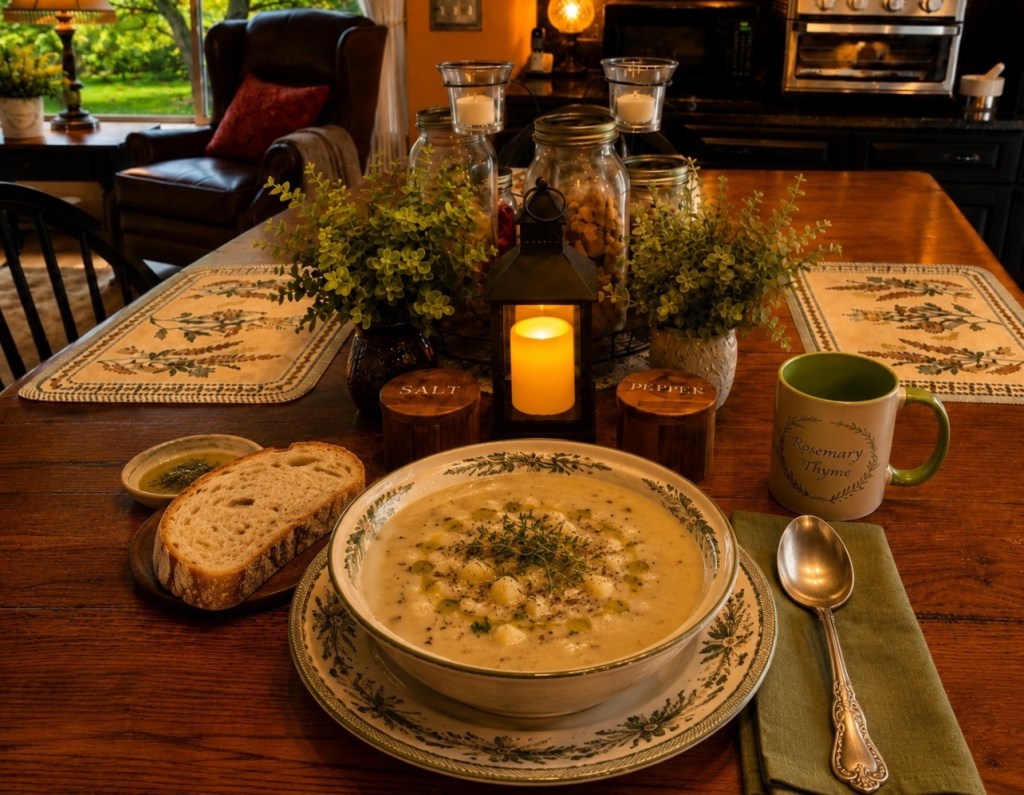
Cozy, creamy, and completely dairy-free! The secret? Cannellini beans create a silky texture while adding protein and fiber. It’s comfort food made with simple pantry ingredients. 💚
This week, I received some news that broke my heart.
For many years, I have followed Jackie and Shadow, the beautiful bald eagles of Big Bear. I watched them return to their nest, prepare it for another season, care for their eggs and raise their young. Year after year, they became a small but treasured part of the rhythm of the seasons for me.
Jackie and Shadow had been together for eight years.
This week, Jackie died.
I was surprised by how deeply I felt the loss of a wild eagle I had never touched and had only known through a camera. But perhaps that is one of the gifts of loving God’s creation. We don’t have to possess something for it to become precious to us.
And then, on that very same day, something happened in my own little corner of the world.
I opened the door to let Candy outside, and from my Vego Garden flew a beautiful black butterfly with yellow markings.
And then another.
Earlier this summer, I had watched black swallowtail caterpillars living and feeding among the plants in that garden. Eventually they disappeared, and I wondered where they had gone.
Now two beautiful butterflies were taking flight from the very place where those little caterpillars had once fed and grown.
I stood there thinking about Jackie.
One beautiful life had ended, while right before my eyes, two others seemed to be beginning a completely new chapter.
It felt like one of those quiet moments when God gently reminds us to look around.
Life has seasons.
There is a time for beginnings and a time for endings. There are moments when we have to say goodbye, even when we aren’t ready. And there are moments when, sometimes unexpectedly, new life unfolds right in front of us.
The butterflies did not take away my sadness over Jackie. They weren’t supposed to.
But they reminded me that sorrow and hope can exist together.
As Christians, we believe that death is not the end of the story. We grieve because we love, but we also live with the promise of resurrection and new life.
Perhaps that is why those two butterflies touched me so deeply.
On a day when I was thinking about a beautiful pair of wings that would no longer return to a familiar nest, I opened my own back door and watched two new pairs of wings rise from my garden.
Sometimes God’s reminders are not loud.
Sometimes they are as gentle as wings.
“Behold, I make all things new.” — Revelation 21:5
🌿 May we notice the quiet reminders of hope God places along our path, especially on the days when our hearts are hurting.
Fresh strawberries, fragrant basil, a squeeze of lime, and sparkling strawberry flavor make this such a refreshing summer drink. It has all the fun of a pretty patio margarita—without the alcohol and without loading it up with sugar.
Sometimes the simplest summer ingredients make the prettiest drinks at the Rosemary Thyme Table. 🍓🌿
Strawberry Basil Margarita Mocktail
Makes 2
Ingredients
4–5 fresh strawberries, hulled
4–5 fresh basil leaves, plus more for garnish
Juice of 1 lime
1 teaspoon honey or preferred sweetener, optional
1 bottle Strawberry Sparkling ICE, chilled
Ice
Lime wedges and fresh strawberries, for garnish
For the rim, optional
Lime wedge
A little coarse salt or a salt-and-Swerve mixture
Directions
Add the strawberries, basil leaves, and lime juice to a small glass or measuring cup. Gently muddle until the strawberries release their juices and the basil becomes fragrant.
Taste and add a little honey or sweetener only if the strawberries need it.
If desired, rub a lime wedge around the rims of two glasses and dip them lightly into the rim mixture.
Fill the glasses with ice.
Divide the strawberry-basil mixture between the glasses.
Slowly pour chilled Strawberry Sparkling ICE over each and gently stir.
Garnish with a fresh strawberry, lime wedge, and small sprig of basil.
🌿 Rosemary Thyme Tip: For an extra-pretty summer glass, slice a strawberry and a few basil leaves and tuck them among the ice before adding the sparkling drink.
The Rosemary Thyme Table — Fall in Love with Home Again. 🌿🏡
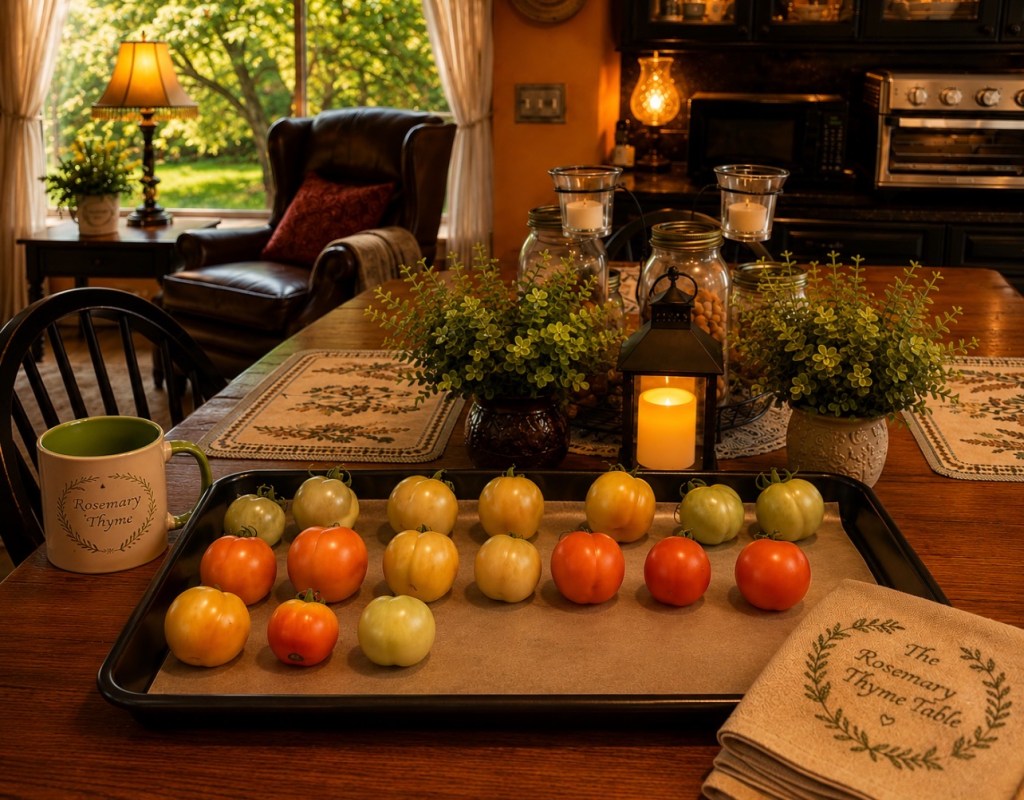
This week marked a little summertime milestone at our house — the last week for buying tomatoes from the grocery store!
Our first garden tomatoes are coming in, and we’ve been picking them just as they begin to blush and bringing them inside to finish ripening. Now the kitchen is filling with tomatoes in every shade from pale green to golden orange to beautiful garden red.
There’s something so satisfying about growing even a little bit of the food that finds its way to your table. Soon these will be sliced for sandwiches and burgers, tossed into salads, and tucked into some of our favorite summer recipes.
For now, I’m simply enjoying watching them ripen. 🍅💛
Sometimes the simplest pleasures of home are the sweetest ones.
🌿 The Rosemary Thyme Table Fall in Love with Home Again.
From an English chemist’s shop to a bottle in our pantry
There are certain ingredients we use so routinely that we rarely stop to wonder where they came from. Worcestershire sauce is one of them.
A splash goes into meatloaf, burgers, marinades, gravies, soups and sauces, adding that little something you can taste but can’t quite identify.
At our house, it also started a pronunciation debate.
Dennis has long jokingly called it “Wor-Chester sauce.” So one afternoon I finally decided to settle the matter and looked up the proper pronunciation.
As it turns out, all those letters are rather misleading.
British English:WUSS-tuh-shuh American English:WUSS-ter-sher
Both are recognizable pronunciations of Worcestershire, with the British pronunciation dropping even more of those intimidating-looking letters.
Once I had solved that little mystery, another occurred to me:
How did this unusual English sauce come to be in the first place?
And that story turned out to be even more interesting.
From Worcester, England
Worcestershire sauce takes its name from the English county of Worcestershire, and its story begins in the city of Worcester.
In the 1830s, two Worcester chemists, John Wheeley Lea and William Henry Perrins, created a savory condiment that would eventually bear their names.
In 1837, Lea & Perrins Worcestershire Sauce went on sale.
The company still produces its famous sauce in Worcester today.
A Sauce That Needed Time
One of the most delightful parts of the story is that Worcestershire sauce wasn’t simply mixed together one afternoon and immediately declared a success.
Time was an essential ingredient.
According to the history told by Lea & Perrins, the mixture was allowed to mature for 18 months. During that long aging process, the ingredients developed the deep and distinctive flavor that would eventually make Worcestershire sauce famous.
Even today, Lea & Perrins says its famous blend takes 18 months to mature.
There’s something wonderfully old-fashioned about that.
Some flavors simply cannot be hurried.
A Little Mystery From India
There’s another intriguing chapter in the Worcestershire story.
The traditional tale says the inspiration for the sauce came to England from India, where British travelers had encountered intensely flavored sauces and condiments.
For years, one version of the story credited a nobleman known as Lord Sandys, who supposedly returned from India wanting a sauce recreated for him.
Historians, however, have questioned parts of that story, particularly claims about Lord Sandys’ supposed position in Bengal.
So while Indian culinary influences very likely played a part in the sauce’s development, some of the colorful details handed down over the years may be a mixture of history and clever 19th-century storytelling.
Kitchen history often comes with a little mystery.
What Makes Worcestershire Sauce Taste Like Worcestershire Sauce?
Worcestershire sauce is difficult to describe because it isn’t simply salty, sweet, sour or savory.
It’s a little of everything.
The familiar Lea & Perrins sauce sold in America contains ingredients including vinegar, molasses, sugar, onion, anchovies, garlic, cloves, tamarind and chili pepper extract, along with other flavorings.
The anchovies provide deep savory flavor. Vinegar contributes acidity. Molasses and sugar add sweetness, while tamarind brings its own distinctive fruity tartness.
Then those flavors are given time to mingle and mature.
Today we have a wonderful word for much of the rich, savory quality Worcestershire brings to food:
Umami.
It helps explain why just a teaspoon or two can make a gravy, burger or meatloaf taste richer without anyone at the table necessarily being able to identify what’s in it.
From Worcester to Kitchens Around the World
Worcestershire sauce didn’t remain a local English curiosity for very long.
By the end of the 1840s, Lea & Perrins Worcestershire Sauce had developed an international reputation and was being exported throughout the British Empire.
Eventually, that distinctive little bottle traveled far beyond England.
Today Worcestershire sauce can be found in kitchens around the world, while the original Lea & Perrins sauce continues to be made in Worcester.
That’s quite a journey for something that began with two English chemists nearly two centuries ago.
The Little Bottle in the Pantry
Perhaps that’s what I enjoy most about kitchen history.
Our kitchens are filled with little connections to people and places we may never have thought about.
A bottle of Worcestershire sauce isn’t just something we shake into a meatloaf or stir into a gravy.
It connects today’s kitchen with two chemists in Worcester nearly two centuries ago, an old-fashioned process of aging and fermentation, ingredients and influences from different parts of the world, and generations of cooks who discovered that just a splash could make dinner taste a little better.
And now that I know its history, I think I’ll appreciate that familiar little bottle a bit more the next time I reach for it.
I will also pronounce it correctly:
WUSS-ter-sher.
Dennis, however, will almost certainly continue to call it “Wor-Chester sauce.”
Some family traditions are apparently harder to change than others. 😂
Rosemary Thyme Kitchen History Stories from the ingredients, dishes and traditions that found their way to our tables.
Rosemary Thyme Table — Fall in Love with Home Again. 🌿



 Rosemary Thyme Cast-Iron Sirloin Steak Bites
 With Baby Potatoes, Green Beans & Sweet Onions
 Ingredients
 Finish
 Instructions
 Rosemary Thyme Blessing



 Instructions
 Preheat oven
 Mix gently
 Shape
 Make the glaze
 Bake
 Rest
 Kitchen Notes